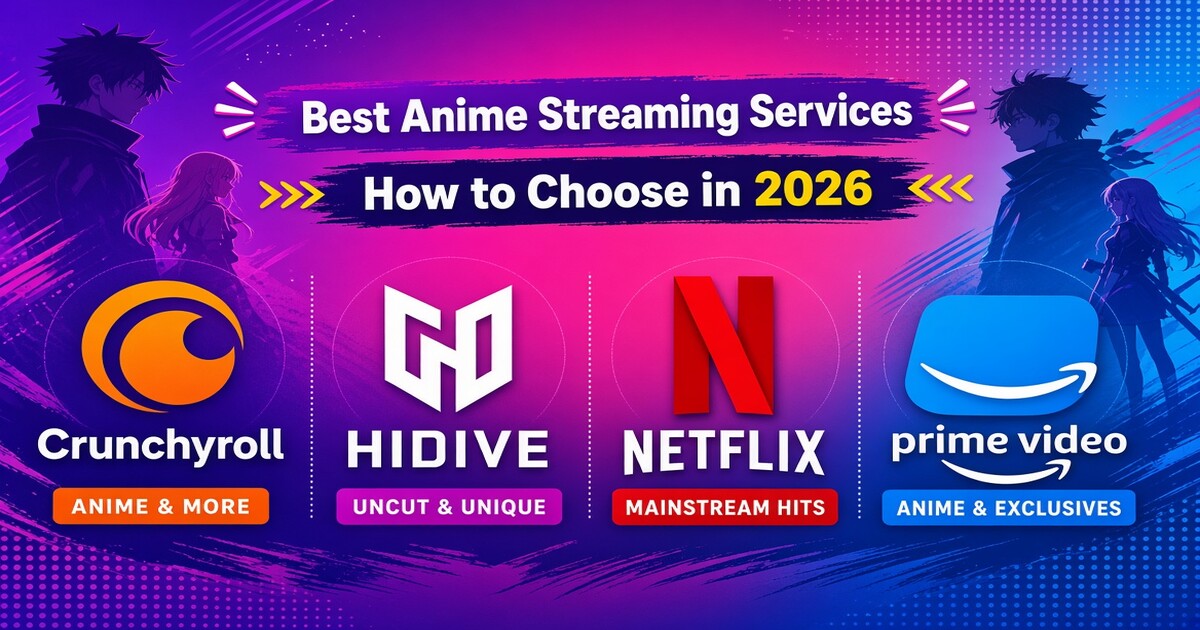
Searching for the best anime streaming services usually returns a list sorted by catalog size, which is the least useful number when you are deciding what to pay for this month. What actually decides the answer is narrower: how quickly you want new episodes, whether you need English dubs, and whether you work through one seasonal show or a long back catalog. Crunchyroll is built around the weekly simulcast cycle, HIDIVE serves a smaller and more specific library, and Netflix and Prime Video treat anime as one shelf inside a general subscription. Matching the service to those three habits costs less than subscribing to everything and hoping.
What Separates the Best Anime Streaming Services
Streaming catalogs are not fixed libraries. A service buys regional licenses, often exclusive and time limited, so the same brand carries different shows in the United States, Germany, India, and Brazil. That fact alone explains most disagreement in anime recommendation threads, where two viewers compare a title that only one of them can legally stream. Before comparing brands, confirm that the specific series you want is listed for your country.
The criteria that decide a subscription, in rough order of how much they change the experience:
- Simulcast coverage: how many current-season titles appear within hours of the Japanese broadcast, and how consistently the service holds that schedule.
- Subtitle and dub policy: whether dubs exist at all, how far behind they run, and whether the subtitle track translates the Japanese audio or the English dub.
- Catalog depth in your genre: a service can be deep in shonen and thin in shojo, mecha, sports, or older classics.
- Delivery: video quality ceiling, offline downloads, simultaneous streams, and whether an app exists for your TV or console.
- Price structure: ad-supported versus ad-free, monthly versus annual, and whether the tier you can afford includes downloads.
- Language support: subtitle languages beyond English, and whether the interface and search work in your language.
Rank those six by what would make you cancel, not by what sounds impressive on a feature list. If you watch the same evening an episode airs in Japan, simulcast coverage outranks everything else. If you only watch finished series, catalog depth and offline downloads matter far more than same-day delivery.
Crunchyroll, HIDIVE, Netflix, and Prime Video Compared
| Service | Library focus | New episodes | English dubs | Offline downloads | Fits |
|---|---|---|---|---|---|
| Crunchyroll | Seasonal simulcasts plus a large back catalog | Same-day subtitled releases for most current shows | Broad, usually weeks behind the broadcast | Yes, on paid tiers | Viewers who follow ongoing seasons |
| HIDIVE | Smaller curated catalog, strong in specific genres and older titles | Simulcasts for selected titles | Selective, decided title by title | Yes, on the paid plan | Viewers hunting niche or older series |
| Netflix | Licensed series plus its own anime productions | Batch releases, rarely same-day | Heavy investment in dubs | Yes | Viewers already paying for Netflix |
| Prime Video | Anime as one shelf, plus add-on channels | Limited same-day coverage | Varies by title | Yes | Households already using Prime |
| Disney+ | Small anime shelf that varies widely by region | Rare | Limited | Yes | Families bundling with other Disney content |
| Free ad-supported services | Rotating back catalog | Delayed or none | Rare | No | Trying a series before paying |
Two mechanics explain most of the difference between these rows. The first is exclusivity: in a given country, a current season is usually licensed to one service, so the question is not which library is better but which one holds your list. The second is release model. A weekly simulcast gives you a fixed appointment and keeps discussion current; a batch drop lets you watch a whole season in a weekend but puts you weeks or months behind everyone else. Neither is wrong, but they suit different viewing habits, and switching between them mid-season is where most subscription regret comes from.
Treat the table as a description of how each service is generally structured, not a promise about a specific title. Licenses expire and move, and the anime shelf on a general entertainment platform can be a fraction of its size in another country.
Which Anime Streaming Service Fits Your Watching Habits
| If you | Start with | Why it fits | Do not choose it when |
|---|---|---|---|
| Follow three or more current-season shows | A simulcast-focused service | The weekly schedule keeps you current with the discussion | You need dubs on release day |
| Watch dubs only | Whichever service confirms a dub for your title | Dub availability is decided per title, not per brand | You will not check the audio track before paying |
| Work through long finished series | The service that already holds your title, or a plan you own | Back catalog, offline downloads and stability matter more than speed | You need the newest season in its first week |
| Watch one show a month | A free tier or a subscription you already pay for | Adding a monthly charge rarely pays back at that volume | Ads or delayed episodes would ruin the experience |
| Want niche, older or experimental titles | A curated service or a free ad-supported one | Curated libraries carry what the large platforms skip | Your list is mostly current mainstream shonen |
The pattern behind the table is simple. Pay for access you will use inside the billing period, and let everything else wait.
Dub-first viewers should treat dub availability as the deciding filter rather than a bonus. A subscription without a usable audio track is a full-price rental of nothing, however large the catalog behind it.
Why Simulcasts and Dubs Arrive at Different Times
A simulcast episode is subtitled from material the Japanese licensor delivers ahead of broadcast: the video master, the script, and timing data. Translators, editors, and timers work against that material so the episode can publish within hours. A dub is a separate production. It needs casting, a script adaptation written for lip sync rather than literal accuracy, recording sessions, mixing, and quality review. That chain explains why a dub can trail the Japanese release by weeks or months, and why some titles never receive one at all.
Same-season dubs do exist, usually for the titles a service expects to carry its subscriber numbers, and the decision is made title by title. No service dubs everything it licenses, so "this platform has dubs" is a statement about the platform, not about the show you want.
The choice between subtitles and dubs is not only a preference either. Subtitle translation quality varies between services, and some tracks translate the English dub rather than the original Japanese audio, which changes what you are reading. Voice direction and honorific handling differ too.
Open one episode of the series you are considering, open the audio and subtitle menus, and confirm what is actually there. A show page that advertises an English dub and an episode that offers only Japanese audio with English subtitles are two different products.
When a Free Anime Streaming Tier Is Enough
Free ad-supported anime is real and sometimes good: the advertising-supported catalog on Crunchyroll in several regions, plus services such as Tubi and RetroCrush, plus official studio and publisher channels. What you give up is predictable. Episodes arrive late or in a limited window, titles rotate in and out because the free window is negotiated separately from the paid license, ads interrupt the episode, downloads are unavailable, and the newest season is usually missing.
Free is enough when you want to finish one completed series, when your monthly viewing is a handful of episodes, when you are testing an interface before committing, or when the titles you want are old enough that nobody is guarding them. It stops being enough when you follow a season weekly, need dubs, watch offline on a commute, or find ad breaks disruptive enough that you stop watching altogether.
Run a short test before paying. Name the three titles you most want to watch, then search each one on the free service. If two or more are missing or locked, a paid tier is doing real work for you. If all three are there and you can tolerate ads, the free tier is the cheaper answer.
What Stacking Two or Three Subscriptions Costs
Monthly renewals hide their size. Each individual charge looks small next to a cinema ticket, and none of them feels urgent enough to audit. The problem is not the price of any single service but the ratio between what you pay and what you watch. A subscription kept for one exclusive series gets paid for twelve months and used for two, and the annual plan that seemed like a discount locks that ratio in place.
Rotation is the strategy that fits anime specifically, because the seasonal schedule hands you a natural exit date. Subscribe when the season you follow begins, cancel when it ends, and return for the next one. Annual plans pay off only if you genuinely watch in every season, and even then they are a bet on your own habits rather than a saving.
Shared subscription platforms take a different route to the same problem. DolOffer, for example, sells slots on multi-user plans, so the per-person cost falls below a standalone subscription while the underlying service stays the same. The platform advertises real-time delivery, one-click password reset, SSL encrypted payment, and a 24-hour money-back guarantee. The tradeoff is control: you do not own the account, so the primary holder's choices, a password reset, or a region mismatch become part of your experience. Check how fast a reset is handled, whether the slot matches the library for your country, and what the refund policy covers before you rely on it. Every streaming service also sets its own rules on who may share a plan, so read those rules instead of assuming a shared slot is permitted.
Whatever route you take, write down each subscription you hold, its monthly charge, and its renewal date. Anything you cannot name a current show for is a cancellation candidate.
How to Check a Service Before You Pay for It
- Search the exact title in your region. Licensing is territorial, so a listing for another country tells you nothing about your own.
- Check the release model. Note whether the current season streams weekly or lands in a batch, and how many episodes are already available.
- Open one episode and read the audio and subtitle menus. Confirm the dub and the subtitle language you actually want exist on the episode, not only in marketing copy.
- Confirm the features tied to your tier. Downloads, simultaneous streams, and ad-free viewing usually belong to a specific plan rather than the service as a whole.
- Test the app on the device you watch on. Subtitle sizing, search quality, and playback stability differ between a smart TV app and a browser.
- Record the renewal date and cancellation window. Know how the refund policy works before the charge, not after it.
- Use a trial or free tier where one exists. One evening with the interface answers questions no feature list can.
If two or more of those checks fail, the service is the wrong purchase this month regardless of how large its catalog looks.
Tell Us What You Want to Watch This Season
Send the titles you plan to watch, the country you are streaming from, and whether you need dubs or subtitles only. We will tell you which plan carries those titles in your region and where a shared slot lowers the monthly cost. DolOffer delivers orders in real time, backs access with a one-click password reset, SSL encrypted payment and a 24-hour money-back guarantee, and keeps support online around the clock. Start at doloffer.com and send your list before the next season begins.
FAQ
Is Crunchyroll or HIDIVE better for anime dubs?
Neither is better in general; the dub you want decides it. Crunchyroll dubs a wider share of its seasonal lineup, so a dub-first viewer usually finds more current titles there. HIDIVE dubs selectively and often concentrates on titles it licenses exclusively. Because dub production is decided title by title, the practical test is identical on both services: open the episode page, check the audio menu, and confirm the English track exists for the season you plan to watch. A service with many dubs you will never watch is worth less than one with the three you will.
Can the same anime be on Netflix and Crunchyroll at once?
Sometimes, but not usually for the same season. Anime licenses are typically exclusive to one service in a given country and run for a set term, so a series can move platforms when that term ends. Netflix also commissions and produces its own anime, and those titles stay with Netflix. The reliable check is to search the exact title in your region across the services you already pay for before adding a new subscription, because a press release or a forum post about another country's catalog predicts nothing about yours.
Do I need more than one anime streaming service?
Only if your watchlist spans titles that no single service carries in your country. Most viewers do better by rotating: keep the service covering your current season, cancel when it ends, and switch to whichever platform holds the next title you want. Two subscriptions make sense when you genuinely watch from both in the same month, or when one arrives bundled inside a plan you already pay for and costs nothing extra. Paying twice for the same season is the most common form of anime subscription waste.
Is a shared subscription a safe way to pay less for anime streaming?
It can be, provided the platform is explicit about what it controls. What matters is whether the slot is delivered when promised, how quickly a password reset is handled, whether payment is encrypted, and what the refund policy covers if the slot stops working. Two limits deserve a plain statement: you do not control the account, so the primary holder's actions affect your access, and each streaming service sets its own rules on sharing a plan. Read those rules and the platform's refund terms before you rely on a shared slot.